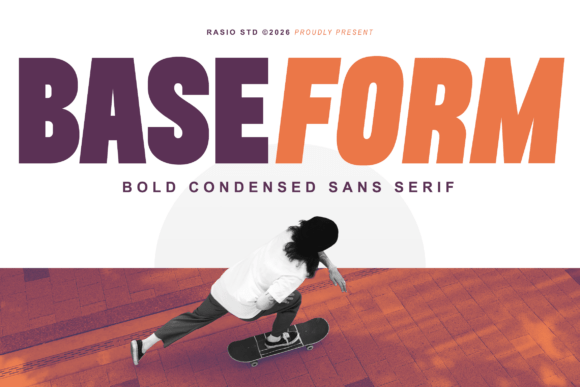
Baseform: A Bold Condensed Sans Serif Display Typeface for Editorial Impact
It was a Tuesday morning—coffee still warm, layout mockups open in Figma—and I was finalizing the cover for a new digital magazine feature on slow living. The headline needed presence without shouting, structure without stiffness. That’s when Baseform stepped in: a bold condensed sans serif display typeface built with strong vertical proportions, compact letterforms, and confident geometric structure. Its tight spacing and heavy stroke gave the title immediate authority, yet its clean lines kept it grounded—not flashy, just sure. That moment crystallized what Baseform does best: it anchors editorial intent with quiet confidence.
Baseform for Digital Magazine Covers and Feature Headlines
As a sans serif font designed for display use, Baseform thrives where attention must land decisively. On magazine covers—especially those exported as PDFs or viewed on tablets—it holds its shape beautifully at large sizes. The strong vertical proportions create rhythm across uneven line lengths, while the compact letterforms prevent awkward gaps in tight headlines like “The Art of Waiting” or “Three Days, One Kitchen.” Because Baseform is a bold condensed sans serif display typeface built with strong vertical proportions, compact letterforms, and confident geometric structure, it scales cleanly from 48pt on a newsletter banner down to 32pt on a mobile-optimized feature opener—no blurring, no visual fatigue. It doesn’t try to be everything; it excels where hierarchy begins.
Baseform for Wedding Guides and Elegant Branding
I recently used Baseform in a client’s printable wedding guide—a 24-page PDF with ceremony timelines, vendor checklists, and mood-board captions. Here, the font’s confident geometric structure brought cohesion to otherwise disparate elements: a minimalist timeline header, a centered “RSVP by May 15” callout, even the subtle divider lines between sections. As a sans serif font, Baseform avoids the formality of serifs while steering clear of playful whimsy—making it ideal for couples who want elegance with edge. Its tight spacing ensures crisp alignment in narrow columns (think two-column layouts on A5 printables), and the heavy stroke gives weight to key phrases without needing bold overrides. Just remember: Baseform is not intended for body copy. For readability in longer passages, I paired it with a relaxed serif font—something with open counters and generous x-height—to let the text breathe.
Baseform for Coaching Workbooks and Printable Planners
In a recent coaching workbook project—a 60-page guided journal with reflection prompts, weekly trackers, and quote cards—Baseform became the voice of intention. Its bold condensed sans serif character made section headers (“Your Core Values,” “Week One Reflection”) feel like gentle directives rather than demands. Because Baseform is built with compact letterforms and tight spacing, it fits cleanly into constrained spaces: top corners of planner pages, sidebars in Notion-style PDF templates, even watermark-style accents behind light-gray backgrounds. On screen, it renders crisply in both dark and light modes; in print, the heavy stroke ensures legibility even on uncoated paper. That said, avoid using Baseform below 20pt in dense worksheets—its geometry reads best when given room to assert itself.
Baseform for Newsletter Headers and Social Media Graphics
For creators sending weekly newsletters—or designing Instagram carousels for course launches—Baseform delivers instant recognition. Its vertical emphasis draws the eye upward, which works beautifully in vertical social formats and email preview panes. As a display font, it’s not meant for paragraph text or caption overlays, but it shines in short, high-impact moments: the “You’re Invited” banner atop a launch email, the “Chapter One” treatment before a long-form essay, or the “Free Resource” badge on a lead magnet graphic. When pairing Baseform with other fonts, I lean into contrast: a friendly, highly readable sans serif font for body copy (think Inter or Manrope), and perhaps a single serif font for pull quotes or bylines. This keeps the typography layered but never cluttered. And because Baseform is a premium font with intentional construction—not just another “bold sans”—it reinforces brand consistency across platforms without feeling repetitive.
What to Check Before Using Baseform in Commercial Fonts Projects
Before adding Baseform to your next ebook, template, or paid printable, take a moment to review what’s included. As a commercial font, licensing terms vary—some versions include only uppercase letters and numerals, others add lowercase alternates, stylistic sets, or extended language support. If your audience includes non-English readers, verify Latin Extended-A coverage. For PDF exports, test how Baseform embeds: does it retain hinting at small sizes? Does it render correctly in Acrobat Reader versus Preview? And if you’re building web-based layouts, confirm whether the font offers WOFF2 files and variable weight options—though Baseform’s strength lies in its singular, purpose-built boldness, not range. Most importantly: trust its role. Baseform isn’t a workhorse body font. It’s the steady hand that sets the tone—the first impression, the anchor point, the quiet pulse beneath thoughtful content.