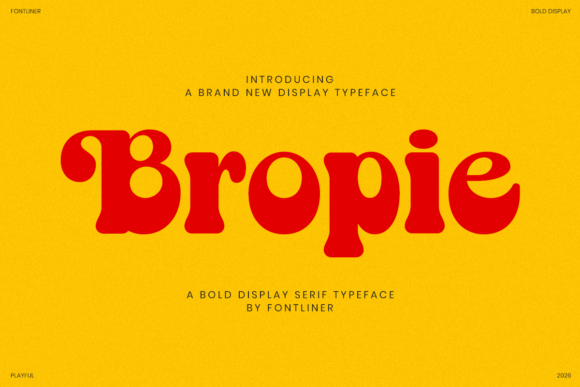
Bropie: A Bold Display Serif Typeface for Editorial Design
Meet Bropie, a bold display serif typeface that radiates playful confidence and retro charm. Inspired by vintage editorial headlines, nostalgic packaging, and expressive branding from the golden era of print, Bropie is more than just another serif font—it’s a deliberate design decision for creators who value tone, texture, and typographic intention. As a publisher and editorial designer, I reach for Bropie when I need a headline font that commands attention without sacrificing warmth or wit—especially in blogs, digital magazines, and branded content where voice matters as much as visuals.
Bropie for Magazine Covers and Print Editorial Branding
Bropie shines brightest on magazine covers and front-of-book spreads—its high-contrast serifs, generous x-height, and slightly condensed proportions create strong visual anchors at large sizes. Unlike many decorative serif fonts, Bropie avoids excessive ornamentation, making it highly legible even in tight crop layouts or low-resolution digital previews. When used across a quarterly publication’s masthead, section dividers, and pull-out quotes, Bropie builds cohesive editorial branding that feels both timeless and freshly intentional. It pairs naturally with a neutral serif (like Adobe Garamond or EB Garamond) for body text and a crisp sans serif (such as Inter or Helvetica Neue) for captions and metadata—ensuring hierarchy stays clear and reading flow remains unbroken.
Bropie for Ebook Titles and Chapter Openers
As an ebook creator, I’ve tested dozens of display fonts for title pages and chapter headings—and Bropie stands out for its balance of personality and professionalism. Its retro charm adds character to lifestyle, memoir, or creative nonfiction titles without veering into kitsch, while its sturdy letterforms hold up beautifully in both PDF exports and EPUB reflowable formats. For chapter openers, I use Bropie at 36–48pt with generous tracking, often centered above a thin rule or subtle background tint. Because Bropie is a display serif typeface—not meant for extended body copy—it keeps readers oriented: “This is a moment to pause, absorb, and lean in.” That psychological cue boosts engagement, especially in long-form digital reading where visual rhythm directly affects retention.
Bropie for Newsletter Headers and Social Media Quote Graphics
Bropie transforms routine newsletter headers and Instagram quote cards into signature moments of brand recognition. Its playful confidence makes it ideal for creators building a distinct voice—think wellness coaches quoting affirmations, indie publishers teasing new releases, or food bloggers highlighting seasonal recipes. On screen, Bropie renders cleanly across modern browsers and email clients (when embedded as webfont or converted to outlined graphics), and its strong vertical stress ensures readability even at smaller mobile widths. For accessibility, I always pair Bropie headers with sufficient contrast (at least 4.5:1 against background) and follow up with a legible sans serif for supporting text—keeping the focus on clarity, not just aesthetics.
Bropie for Printable Guides, Workbooks, and Lead Magnets
When designing printable guides, coaching workbooks, or lead magnets, Bropie delivers immediate visual authority. Its nostalgic packaging roots make it perfect for recipe collections, wedding planning checklists, or self-paced learning modules—contexts where warmth and trust are as critical as information. In print, Bropie performs reliably at 24–36pt for section headers and cover titles; its ink-friendly shapes minimize fill-in at standard laser or offset resolutions. Importantly, Bropie includes stylistic alternates and ligatures that add subtle polish—like replacing “fi” or “fl” with custom-connected forms—giving your printables a hand-crafted feel without manual tweaking. Just confirm your license permits commercial use for downloadable templates, which it does under standard Bropie licensing.
Bropie for Blog Post Headings and Content Branding Systems
For bloggers and independent publishers building a recognizable content brand, Bropie functions as a consistent tonal signature. Used across H1s, featured post banners, and sidebar callouts, it reinforces voice before a single word is read. Unlike generic serif fonts, Bropie’s retro charm invites curiosity—readers subconsciously associate it with thoughtfully curated content, not algorithm-driven feeds. I recommend using Bropie only for primary headings (H1, H2) and limiting usage to two weights (Regular and Bold) to preserve impact. Avoid stretching or condensing the font—it was designed for optical balance, not distortion. And because it’s a premium serif font built for editorial use, it includes full Latin character sets and basic multilingual support—ideal for bilingual newsletters or globally distributed ebooks.
Bropie for Wedding Invitations and Elegant Branding Projects
Though rooted in editorial history, Bropie’s expressive branding DNA makes it unexpectedly powerful for wedding invitations, boutique packaging, and artisanal product launches. Its confident serifs evoke mid-century elegance without stiffness—ideal for couples seeking sophistication with soul. In Canva, Figma, or Adobe InDesign, Bropie scales gracefully from 120pt monogram motifs down to 18pt RSVP instructions (with appropriate leading and spacing). For best results, pair it with a delicate script font for names and a warm, low-contrast serif for body copy—creating layered yet harmonious typography. As with all commercial fonts, ensure your Bropie license covers client-facing deliverables like printed stationery or digital invitation suites.
Bropie Font Pairing Strategies for Editorial Designers
Bropie works hardest when paired intentionally. As a bold display serif typeface, it needs breathing room—and a reliable partner for sustained reading. My go-to pairings: Adobe Caslon Pro for classic bookish depth, Source Serif Pro for clean digital readability, or Lora for free, open-source harmony. For captions, navigation, or footnotes, I choose a neutral sans serif—never another display font. Bropie doesn’t need competition; it needs context. And because it’s a carefully crafted serif font—not a rushed webfont bundle—it includes true italics, small caps, and OpenType features that elevate professional output. Before finalizing any layout, I always test Bropie in actual export conditions: PDF bleed zones, mobile newsletter previews, and printed proofs—to ensure its retro charm translates faithfully, not fuzzily.