Dancing Donuts Font for Bold Brand Identity Projects
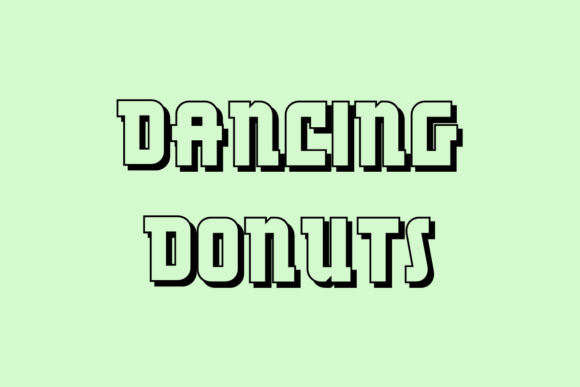
It started with a blank brand board and a local ceramicist’s request: “Something joyful, handmade, and unmistakably *her*—but not too sweet.” I opened my fonts folder, scrolled past the usual suspects, and landed on Dancing Donuts. Not because it sounded like a dessert trend, but because it looked like energy made visible—a bold, outline display font with drop shadows that instantly added dimension without clutter. As a working designer who regularly downloads Freebies to test before committing to premium Fonts, I treated this one like a sketch tool: fast, expressive, and full of personality.
Dancing Donuts for Logotypes That Stand Out in Crowded Spaces
I dropped Dancing Donuts into a simple logotype mockup—just her name in all caps over a muted clay-toned background. The 3D-looking characters popped immediately. That subtle drop shadow? It wasn’t just visual flair; it created natural depth against flat surfaces, which mattered when we later printed it on matte ceramic coasters and kraft paper tags. Because Dancing Donuts is strictly a display font—not meant for paragraphs or fine print—it worked perfectly as a logo anchor. No kerning overhauls needed, no optical adjustments: the spacing felt intentional, even playful. For small business owners building their first brand identity, that kind of out-of-the-box readiness is gold. Just remember: use it for short-form text only. Names, slogans, shop signs—not ingredient lists or policy pages.
Dancing Donuts on Posters and Printed Marketing Materials
We needed a series of A2 posters for her studio open house. With Dancing Donuts, the headline “Handmade Here” took center stage—no extra effects, no layering tricks. Its bold outline held up beautifully at large scale, and the drop shadows translated cleanly to CMYK print. I tested it alongside a warm, humanist sans serif (like Poppins Light) for body copy, and the contrast was effortless: Dancing Donuts brought rhythm and character; the sans kept things grounded and legible. That pairing worked across posters, flyers, and even vinyl window decals. As a designer, I appreciated how little tweaking it needed—no manual shadow duplication, no stroke expansions. It arrived ready-to-use, which saved time when balancing multiple client deadlines and tight print turnarounds.
Dancing Donuts for Website Headers and Digital Branding
Yes, Dancing Donuts works on websites—but with intention. I used it only in the hero section header (“Stoneware • Glaze • Studio”) and in animated hover states for primary CTAs. Because it’s a display font with strong visual weight, it commanded attention without competing with navigation or content blocks. I paired it with a clean, variable sans serif for everything else—ensuring readability on mobile and accessibility compliance. The font’s 3D appearance added warmth to an otherwise minimal web layout, subtly reinforcing the tactile, hands-on nature of her craft. If you’re sourcing Freebies for web projects, double-check that the Fonts include web-optimized formats (WOFF2 is ideal). Dancing Donuts delivered that, making implementation smooth across Figma prototypes and live WordPress builds.
Dancing Donuts on Fabric Prints and Merchandise Design
This is where Dancing Donuts surprised me most. We screen-printed her studio name onto cotton tote bags using a single-color ink process—and the bold outline held crisp edges even on textured fabric. The drop shadow isn’t literal here; it’s implied through contrast and weight, so it scaled down gracefully to 1.5-inch tall embroidery on aprons too. For makers launching merch lines—think mugs, tea towels, enamel pins—Dancing Donuts offers instant charm without sacrificing reproducibility. Since it’s a complete set of uppercase and lowercase characters (plus numerals and basic punctuation), it handled product labels and care instructions with ease. Just avoid ultra-thin fabrics or high-detail halftones—the strength of this font is its confident simplicity.
How Dancing Donuts Fits Into a Real Brand System
Dancing Donuts doesn’t try to be everything. It’s not a text face. It’s not minimalist. It’s not neutral. And that’s exactly why it shines in branding for creative studios, artisanal shops, and neighborhood cafes where authenticity and warmth matter more than corporate polish. In our project, it became the “voice” of the brand—while supporting typefaces handled function. I paired it with a gentle serif for packaging copy (to echo hand-thrown pottery’s organic flow) and a rounded sans for social media graphics (to keep things friendly and modern). That kind of thoughtful font pairing turns a fun Freebie into a strategic Fonts choice.
Dancing Donuts for Social Media Graphics and Instagram Story Text
We built a batch of Instagram templates—quote cards, event announcements, new collection teasers—and Dancing Donuts gave them instant cohesion. Its bounce and dimension read clearly even at small sizes on mobile screens. Because the drop shadows are built-in—not added as layer effects—it rendered consistently across devices and editing apps. For designers managing multiple small business accounts, having one expressive Fonts option that works across Canva, Photoshop, and Figma saves real hours. And since it’s a Freebie, there’s zero licensing friction for commercial posts—no need to chase usage rights mid-campaign.
If you’re weighing whether Dancing Donuts fits your next branding, packaging, or digital project: test it early, use it boldly, and pair it wisely. It’s not a background player—it’s the spark that makes a brand feel alive. And sometimes, the best design decisions start with downloading a Freebie that just *clicks*. This one did.