Slime Drip Halloween Font for Spooky, Scroll-Stopping Campaigns
It’s 3:47 p.m. on a Tuesday — three days before the Halloween content calendar goes live — and I’m tweaking a YouTube thumbnail for a “Spooktacular Sale” teaser video. The background is moody black with fog gradients, the product mockup glows faintly, and the headline needs to land *immediately*. That’s when I drop in Slime Drip Halloween. Not as filler. Not as a last-minute gimmick. As intentional visual punctuation — a Color Fonts choice that shifts the entire tone from “seasonal promo” to “unmissable vibe.”
Slime Drip Halloween for Instagram Reels Covers and Fast-Scrolling Feeds
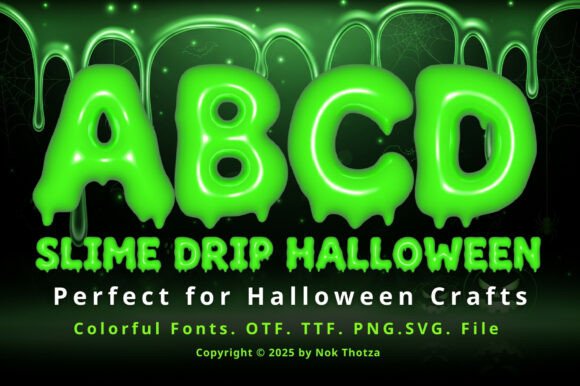
Slime Drip Halloween isn’t built for paragraphs. It’s engineered for micro-moments — the 0.8 seconds your eye lingers on a Reels cover before swiping. Its glowing, dripping 3D effect reads instantly against dark or high-contrast backgrounds, and because it’s a Color Fonts file (OpenType-SVG), the slime texture, inner glow, and subtle green-to-purple gradient render cleanly *without* layering effects or raster overlays. I used it for a 5-word callout — “TRICK OR TREAT EARLY” — over a blurred candy corn photo. On mobile preview, it held weight at 48pt, with no visual bleed or fuzzy edges. That said: avoid using Slime Drip Halloween for body text, captions under 32pt, or anything requiring precise character spacing (like acronyms or hashtags). It’s a display font — bold, expressive, and best reserved for primary headlines, campaign labels, and logo-style text.
Slime Drip Halloween for Pinterest Pins and Editorial Halloween Graphics
Pinterest rewards clarity *and* personality — especially in seasonal verticals like Halloween DIY, party planning, or spooky home decor. When designing a pin titled “10 Gooey Halloween Party Ideas,” I paired Slime Drip Halloween for the title with Inter (a clean, neutral sans serif) for supporting bullet points. The contrast worked because Slime Drip Halloween did the emotional heavy lifting — its playful-yet-creepy energy signaled fun *and* thematic cohesion — while the sans serif kept scannability intact. As a Fonts asset, it includes stylistic alternates (like a “dripping only” version without glow) and basic ligatures, which helped tighten awkward letter pairs like “TT” or “FF” in tighter layouts. Just remember: if your pin uses light backgrounds, test the glow effect — some lighter variants of the slime color may lose contrast. Stick to dark or mid-tone backdrops for maximum impact.
Slime Drip Halloween for Email Banners and Digital Ad Headers
Digital ads demand instant recognition — and email banners need to survive inbox previews. Here’s where Slime Drip Halloween shines *selectively*. I dropped it into a 600×200px email header for a limited-time course launch (“Ghoul Your Graphic Design Skills”). At scale, the font’s 3D depth read clearly even when compressed by Gmail’s image proxy. But — and this is critical — I never used it for subheadlines, CTA buttons, or legal disclaimers. Those stayed in Montserrat Bold. Why? Because Slime Drip Halloween is a Color Fonts display typeface, not a functional UI font. Its strength lies in mood-setting, not information hierarchy. For ads, I also verified licensing: yes, it supports commercial use across platforms, including Facebook/Instagram ad creatives and Canva templates (as long as you’re using the desktop app or uploading the OTF/SVG files directly — web-based Canva fonts won’t include the color layers).
Slime Drip Halloween for Branded Template Packs and Social Media Kits
If you design branded assets for creators — think Instagram story kits, TikTok transition packs, or Canva template bundles — Slime Drip Halloween adds immediate seasonal value. I embedded it into a “Halloween Content Kit” with pre-sized frames for Stories, Feed posts, and Pinterest. Users loved that the slime effect wasn’t just aesthetic; it was *editable*: toggling layers in Figma or adjusting blend modes in Photoshop gave control over drip intensity or glow saturation. As a Fonts file, it comes in OTF + SVG formats, so designers can choose based on platform support. No multilingual glyphs beyond basic Latin (A–Z, numerals, common punctuation), so avoid it for bilingual campaigns unless you’re pairing it with a robust secondary typeface. And always pair it intentionally: try Slime Drip Halloween + Playfair Display for vintage-horror elegance, or Slime Drip Halloween + DM Sans for modern contrast. Never pair it with another decorative or script font — the personality clash dilutes impact.
Slime Drip Halloween for Web Banners and Landing Page Headers
On a landing page banner for an online shop’s Halloween collection, Slime Drip Halloween delivered exactly what we needed: visceral, on-brand energy in under five words. “SPOOKY STOCK IS LIVE” popped against a matte-black hero section, and because the font renders via native browser support for color fonts (Chrome, Safari, Edge), no fallback was needed — unlike older layered PNG solutions. That said, always test on iOS Safari: some older versions don’t fully support SVG color fonts, so keep a lightweight sans-serif fallback declared in your CSS stack. Also — skip using Slime Drip Halloween for navigation menus, footer text, or any interactive element requiring accessibility compliance (WCAG AA contrast ratios are hard to hit with glowing, semi-transparent slime layers). Reserve it for hero headers, section dividers, and animated hover states where its personality enhances, rather than obscures, intent.