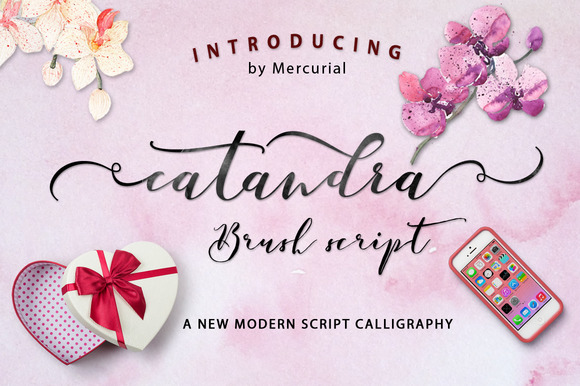
Catandra Script: A Handmade Modern Script Font for Thoughtful Design
It started with a simple task—revising the header of my seasonal lifestyle blog. I’d been using a generic script font for months, one that felt increasingly distant from the warmth and intention behind each post: slow mornings, handmade ceramics, garden-to-table recipes, quiet reflections on craft and care. What I needed wasn’t just decoration—it was resonance. That’s when I downloaded Catandra Script, a handmade, charming, modern script with a new fresh touch—and began designing not just for contrast or novelty, but for continuity of voice.
Catandra Script for Wedding Invitations and Elegant Branding
Two weeks later, I used Catandra Script to typeset a friend’s wedding invitation suite—a small-run, letterpress-inspired PDF guide for guests, paired with printed keepsake cards. The charm of Catandra Script lies in its gentle irregularity: subtle variations in stroke weight, soft entry/exit terminals, and a rhythm that breathes like handwriting—but never slips into informality. It holds elegance without stiffness. As a promo font, it carries presence at 36pt on vellum paper and retains legibility even scaled down to 18pt for RSVP details. For wedding stationery designers, this isn’t just another script fonts option—it’s a tone-setter that quietly signals intention, craftsmanship, and personal warmth before the first word is read.
Catandra Script for Blog Headers and Digital Magazine Covers
I swapped out my old blog header font for Catandra Script and paired it with a relaxed serif (a well-spaced Garamond variant) for body text. Instantly, the space above the fold felt more curated—not louder, but *clearer*. Catandra Script works beautifully as a display font for blog headers because it commands attention without shouting. Its open counters and generous x-height support screen readability, especially on tablets and larger mobile viewports. In digital magazine layouts, I’ve used it for cover titles and chapter openers—never for long-form body copy, of course—but always where emotional resonance matters more than speed of scanning. It’s a modern script that doesn’t sacrifice clarity for charm.
Catandra Script for Printable Planners and Coaching Workbooks
Last month, I designed a printable seasonal planner for a mindfulness coaching client. We wanted the title page and weekly reflection prompts to feel inviting—not clinical. Catandra Script became the anchor: used for section headers (“Pause Here,” “What Nourished You?”), decorative dividers, and the workbook’s logo lockup. Because it’s a handmade script, it avoids the cold precision of vector-based scripts—giving printed pages a tactile, human quality. When exported to PDF, Catandra Script renders cleanly across devices, and its included OpenType features—like discretionary ligatures and contextual alternates—add subtle nuance without manual tweaking. As a promo asset for coaches and educators, it elevates downloadable content without requiring design expertise.
Catandra Script for T-Shirts, Labels, and Small-Batch Signage
I tested Catandra Script in physical form too—cutting vinyl for a local ceramicist’s product labels and screen-printing a limited run of t-shirts for her studio launch. Its balanced proportions and moderate contrast translate beautifully to both print and cut paths. Unlike some delicate script fonts, Catandra Script holds up at small sizes (down to 14pt on 2” x 1” product tags) and maintains character at large scale (24” signage). The “fresh touch” mentioned in its description isn’t marketing fluff—it’s visible in how the lowercase a and g retain personality without sacrificing cohesion, and how the capitals have just enough flourish to feel celebratory, never fussy. For makers and indie brands choosing fonts for physical goods, Catandra Script bridges authenticity and polish.
Catandra Script for Letterheads and Editorial Identity Systems
A designer friend asked me to review Catandra Script for a boutique editorial studio’s rebrand—specifically for letterheads, email signatures, and newsletter graphics. We tested it alongside three other script fonts, all labeled “modern.” What set Catandra Script apart was its consistency in tone across weights and contexts. It didn’t demand attention; it earned it. Used sparingly—as a single-line masthead or a pull quote accent—it reinforced brand identity without overwhelming the layout. Paired with a neutral sans serif (like Poppins Light for captions and navigation), Catandra Script created visual hierarchy that felt intuitive, not imposed. As a promo tool for editorial studios, it supports recognition and recall—not through repetition, but through quiet distinction.
Practical Notes Before You Use Catandra Script
Before integrating Catandra Script into client work or paid digital products, I checked the file package: it includes OTF and WOFF formats, standard Latin character sets (with full diacritic support for French, Spanish, and German), and no hidden limitations on commercial use. There are no bold or italic variants—this is a single-weight display script, best used intentionally, not ubiquitously. I recommend testing it in your intended output environment: preview PDF exports on multiple devices, test SVG embedding for web use, and verify spacing in your CMS or email builder. And always pair it thoughtfully—a clean sans serif for UI elements, a warm serif for long-form reading, or even a monospace for contrast in creative layouts.
If you’re building something that carries meaning—not just information—Catandra Script offers more than style. It offers sincerity, measured rhythm, and a handmade sensibility that feels rare in today’s flood of algorithmic fonts. Whether you're setting a recipe ebook title, drafting a heartfelt newsletter graphic, or designing signage for a neighborhood café, Catandra Script invites readers in—not with volume, but with voice.