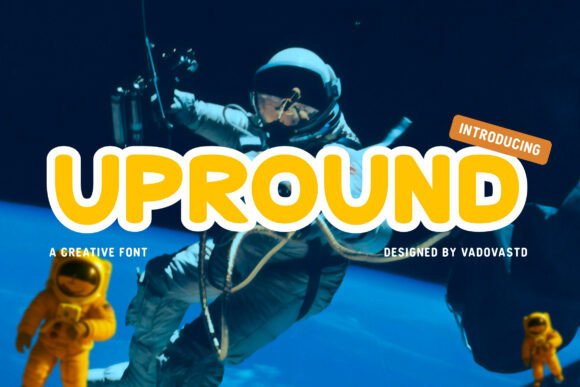
Upround: A Friendly-and-Futuristic Sans Serif Font for Bold Campaign Graphics
It’s 9:47 a.m., and I’m staring at a YouTube thumbnail preview on my phone—tiny, fast-scrolling, competing with 20 other thumbnails in the feed. The headline reads “New Feature Drop!” but it’s getting lost. Too thin. Too neutral. Too forgettable. That’s when I swap in Upround. Suddenly, the text pops—not just louder, but *kinder*, sharper, more intentional. That’s the moment Upround Bold Rounded Creative Font earns its place in my campaign toolkit: not as decoration, but as strategic clarity.
Upround for Instagram Reels Covers and Fast-Scrolling Social Posts
Upround is a thick display sans-serif built for split-second recognition—and Instagram Reels covers demand exactly that. Its ultra-bold weight holds up even when scaled down to 320px wide; its rounded terminals soften the intensity without sacrificing impact. I used it for a 7-day “Tool Tip Tuesdays” series, pairing each Reels cover with a crisp white-on-teal background. No drop shadow needed. No outline required. Just clean, confident Upround text centered over a subtle gradient. Because it’s a sans serif font, it stays legible across iOS and Android previews—even with aggressive compression. And because it’s designed as a creative font, those subtle curves add warmth where sterile tech fonts feel cold.
Upround for Pinterest Pins and Vertical Editorial Design
Pinterest is editorial by nature—people linger, scroll slower, read longer. So when I built a set of “Design System Starter” pins for a small business audience, I leaned into Upround’s dual personality: “friendly-and-futuristic” meant approachable enough for beginners, yet distinct enough to signal premium fonts and thoughtful typography. I used Upround only for the main headline (e.g., “Your First Brand Kit, Done”), then paired it with a light, airy sans serif for body text—no serif needed here. Why? Because Upround already carries enough visual weight to anchor the pin without competing. As a display sans-serif, it doesn’t try to be everything—it excels at being the first thing your eye locks onto.
Upround for YouTube Thumbnail Sets and Consistent Channel Identity
For a recent webinar series on creative workflow tools, I built six thumbnails—all using the same layout, color palette, and Upround for the title treatment. Not just the same font, but the same weight, spacing, and vertical alignment. That consistency turned abstract topics (“Time Blocking,” “Asset Handoff,” “Feedback Loops”) into a cohesive visual rhythm. On mobile, Upround’s generous x-height and open counters kept letters like ‘a’, ‘e’, and ‘s’ fully legible—even at 18pt over a busy background image. As a sans serif font, it avoids the fine serifs that blur or vanish in compressed thumbnails. And yes—I checked the included OTF files before exporting: full Latin character set, no missing accents, commercial license confirmed. No last-minute swaps mid-campaign.
Upround for Email Banners and Mobile-First Promotional Graphics
Email banners live in tight spaces: narrow viewports, variable client rendering, low-resolution screens. I tested Upround across Gmail, Apple Mail, and Outlook—and it held up. Its ultra-bold weight ensures visibility even when images are disabled and fallback fonts kick in. More importantly, its rounded geometry feels inviting in a medium people associate with urgency or clutter. For a limited-time shop promotion, I used Upround only for the offer label (“24-HOUR FLASH”) and the CTA (“Grab Yours”). Everything else—dates, terms, product names—used a neutral, highly legible sans serif. That contrast made the message scannable in under two seconds. This isn’t about shouting—it’s about guiding attention with intention.
Upround for Online Shop Campaigns and Digital Ad Sets
Digital ads move fast. You have 0.8 seconds to register meaning before the scroll. That’s why Upround works so well for short, high-signal copy: “New Arrivals,” “Just Dropped,” “Sale Starts Now.” As a display sans-serif, it’s not meant for paragraphs—but it *is* built for bold declarations. I used it across Meta carousel ads, Google Display banners, and TikTok Spark Ads—always on light or dark backgrounds, never over complex imagery. Its friendly curves keep tone human; its thickness keeps it readable at tiny sizes. And because it’s a premium creative font, it helped differentiate our campaign from competitors relying on system fonts or overused free downloads.
Upround for Branded Content Series and Logo-Style Text Treatments
When building a recurring content series—like “Studio Notes,” a biweekly design insight newsletter—I treated Upround like a visual signature. Not a logo, but logo-adjacent: custom kerning, consistent tracking, always uppercase for titles. It became instantly recognizable across email headers, Notion templates, and Canva social kits. That’s the power of a well-chosen sans serif font: it builds familiarity without needing a full brand system. Pair it with a restrained serif for quotes or a minimalist script for subheaders—and you’ve got a flexible, scalable fonts stack that grows with your content.
If you’re choosing Upround, know this: it’s not a utility font. It’s a statement font. Use it where clarity meets personality—where your message needs to land warmly, memorably, and immediately. Whether you’re designing for Pinterest, YouTube, email, or digital ads, Upround delivers that rare balance: ultra-bold without aggression, rounded without softness, futuristic without alienating. It’s a creative font built for real campaigns—not mockups, not mood boards, but shipped work that moves people.