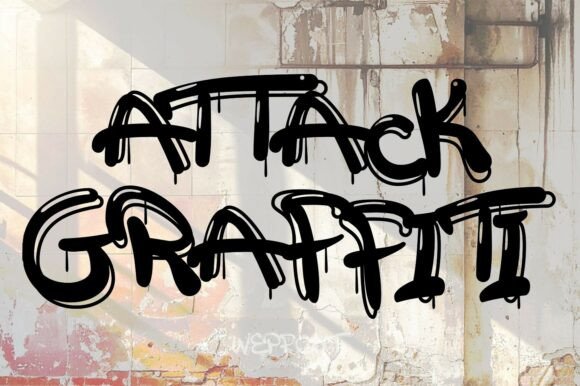
Attack Graffiti: A Raw, Edgy Display Font for Editorial Impact
It was a quiet Tuesday afternoon—coffee lukewarm, layout files open in Figma—when I paused over the cover of a new digital magazine issue I’d been commissioned to design. The theme was urban storytelling: interviews with muralists, essays on public space, photo essays shot under subway platforms and alleyways. The body type was settled—a warm, highly legible serif—but the title needed more than clarity. It needed attitude. That’s when I dropped Attack Graffiti into the headline field. Instantly, the page exhaled. Not louder—but truer. This is how Attack Graffiti works: not as decoration, but as declaration.
Attack Graffiti for Digital Magazine Covers and Editorial Identity
Attack Graffiti is a Decorative display font—not meant for paragraphs or captions, but for moments where voice must cut through noise. Its letterforms carry the kinetic energy of spray-paint drips, sharp angles, and intentional imperfection: uneven baselines, irregular stroke contrast, and glyphs that feel both urgent and hand-drawn. In a digital magazine cover, it doesn’t just sit atop imagery—it converses with it. I used it at 84pt over a gritty street photograph, then scaled it down to 48pt for section headers inside the PDF. At both sizes, it held its character without collapsing into illegibility. Crucially, it remained distinctly Fonts that serve editorial intent—not trend-chasing gimmicks. Because it’s so expressive, it anchors the publication’s tone instantly: confident, unpolished, culturally grounded.
Attack Graffiti for Wedding Invitations and Unexpected Elegance
Yes—even wedding guides. Last month, I helped a small creative studio refine their printable planner series for couples planning nontraditional ceremonies. Their existing script fonts felt too dainty; their sans serifs too neutral. Enter Attack Graffiti. Paired with a soft, low-contrast serif (think: a gentle Garamond variant), it transformed “Reception” into something charged yet sincere—especially in foil-stamped printables. What makes Attack Graffiti work here isn’t irony—it’s authenticity. The font doesn’t pretend to be calligraphic or romantic. Instead, it signals that this wedding celebrates individuality, grit, and real-life texture. As a Decorative typeface, it thrives in short bursts: monogram accents, envelope liners, or chapter openers like “Vows” or “First Dance.” Just avoid using it below 24pt—or for anything requiring formal legibility, like legal disclaimers or RSVP instructions.
Attack Graffiti for Newsletter Headers and Social Media Graphics
For newsletter headers, Attack Graffiti performs best when treated like a visual signature—not a full sentence. I tested it across three formats: a dark-mode email banner (white text on charcoal), an Instagram carousel slide (overlaid on a candid photo of chalk art), and a Substack cover image. In each case, pairing Attack Graffiti with a clean, neutral sans serif (like Inter or Manrope) created immediate hierarchy: the display font commands attention, while the supporting type carries meaning. As Fonts, they complement rather than compete. On mobile, I kept usage minimal—only the newsletter name (“The Unfiltered Feed”) in Attack Graffiti, sized generously at 36px. No tracking adjustments were needed; its natural rhythm holds up well even at smaller display sizes, as long as line length stays tight and background contrast remains high.
Attack Graffiti for Coaching Workbooks and Printable Guides
In a recent coaching workbook project—a 40-page PDF guide on creative boundary-setting—I used Attack Graffiti exclusively for chapter titles (“Claim Your Space,” “Say No Without Guilt”) and pull quotes pulled from client interviews. Why? Because those moments needed emotional resonance—not just information delivery. The rawness of Attack Graffiti mirrors the vulnerability of the content. But—and this matters—it only appears where readers pause, reflect, or reorient. Never in body copy, never in checkboxes or fill-in-the-blank fields. As a Decorative font, its strength lies in contrast: the more grounded your supporting typeface, the more potent Attack Graffiti becomes. Before final export, I confirmed the font included OTF and WOFF2 files, verified commercial licensing covered PDF distribution, and checked that no ligatures or stylistic alternates interfered with copy-paste functionality for users who might annotate digitally.
Attack Graffiti for Recipe Ebooks and Lifestyle Blog Redesigns
A recipe ebook titled *Burnt Ends & Biscuits* gave me the chance to test Attack Graffiti in a warmer, more tactile context. Here, it appeared only on the cover, chapter dividers (“Smoke,” “Sauce,” “Sides”), and the occasional bold ingredient header (“Smoked Brisket Flat”). Paired with a friendly, slightly rounded sans serif for body text and captions, it added narrative texture without overwhelming. Readers told me those chapter breaks “felt like stepping into a new room”—a testament to how well Attack Graffiti supports content structure when used intentionally. As Fonts go, it’s not versatile in the Swiss sense—but it’s deeply reliable within its lane: expressive, memorable, and unmistakably human. Just remember: it’s a display font first, last, and always. Reserve it for moments that earn its energy.
If you’re selecting Attack Graffiti for your next editorial layout—whether it’s a lifestyle blog header, a printable planner, or a digital magazine cover—trust its rawness. Let it do what it does best: declare, disrupt gently, and deepen mood. Then step back, and let your content breathe around it.